Play
Prev
Next

I get ridiculously proud of myself when I score a good deal shopping. I know I shouldn’t be telling everyone that my designer dress was actually on super-clearance due to a defect in the zipper, but I can’t help it. If I bought that $80 dress for a whopping ten bucks, you can bet I’m going to tell you about it. With probably more excitement than is socially acceptable.

Shopping in Taiwan gives me similar thrills. Racks of extremely cheap clothing are everywhere, and it takes almost all my self-control to tell myself I don’t really need another sweatshirt with college logo I’ve never heard of—even if it is a super cute hoodie for only $4. Granted, a lot of the fashion here isn’t really me. I like to think I’m quite girly, but even I have to set up some barriers against all the lace and hearts and baby shades of pink that proliferate.  Although as I sit here I’m donning a shirt of a baby giraffe wearing a bow tie. Not so sure what that has to say about my taste in fashion after two years of living in Asia…

It’s easy to shop in Taiwan. Markets are everywhere, and virtually all of them will have racks of clothes set out to tempt you while purchasing your bubble milk tea. Heck, there’s even a cheap jewelry/purse rack at my favorite dumpling shop! But still, there’s one place that rises above the rest. It’s the place all those other inexpensive street vendors buy their products from. It’s a place called Wufenpu.

Shopping at Wufenpu Taipei Taiwan

Located in Taipei, Wufenpu consists of over 100 wholesale clothing shops. You can literally find anything here, including purses, belts, women’s clothing, men’s clothing, baby clothing, puppy clothing (seriously), jewelry and shoes.

Wufenpu is as inexpensive as it gets in Taiwan, and all of my proudest purchases have come from here. Unfortunately it’s not the easiest place to navigate, and I’ve definitely picked up some treasure-hunting tips along the way.

1. Bargain

I know, they’re telling you the price is only $6 and that’s ridiculously cheap already. But trust me, you can get it for less, and in most cases they are expecting you to offer a counter price.

Shopping Clothes Rack Wufenpu Taipei Taiwan

2. Be Ready To Do Some Diggin’

For every good find at Wufenpu, you’ll have to rummage through about 100 pieces of crap. I seriously have no idea why anyone would need leopard-print-faux-leather leggings or neon-orange-and-green-polka-dotted dresses, but I guess there must be a market for that sort of thing. I promise, there’s more hiding in the streets of Wufenpu than first meets the eye.

Shopping Wufenpu Taipei Taiwan

3.  You Can’t Try Clothes On

This is the only thing about Wufenpu that really irritates me, although I’m sure it’s much better this way for our bank account. I don’t have one of those figures that can pull off anything, so I only make ‘safe’ purchases. This has worked fairly well for me, especially because I typically spend around $5 on each item of clothing I purchase; if it doesn’t work out, it’s not the end of the world. Do know in advance, even if it’s as simple as a jacket, they won’t let you try it on over your clothing.


4. Follow the Crowds

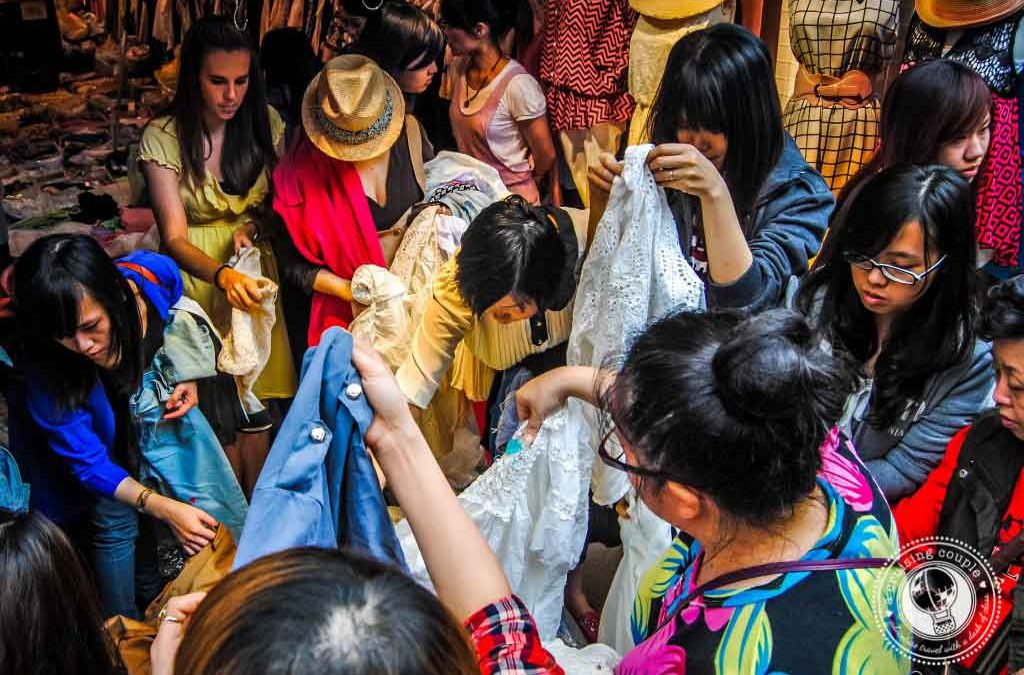
I’m not quite up to date with the latest Korean trends, but Taiwanese people are. If you see a massive crowd of people elbowing at each other in a doorway, flinging wayward clothes over their shoulders, ignoring anything else around them, you’ve struck gold. Figure out a way to join the troops and you’ll be well on your way to scoring designer Korean labels for a fraction of the price. I’m still working at my nudging tactics.

Shopping Sale Wufenpu Taipei Taiwan

5. Avoid Anywhere With Air-Conditioning

If they can afford air-conditioning, you can expect to pay more. Unfortunately these shops tend to be more like boutiques, with higher-quality and better-designed clothing. I unwillingly gravitate to them, and sometimes I splurge a bit if I really think I’m going to fall in love with the item later (you still can’t try anything on here). Prices will typically range from $30-$100, not bad until you remember the price tag on your other purchases.

Dresses Shopping Wufenpu Taipei Taiwan

Even if you’re not a ‘big shopper’, I still recommend Wufenpu to travelers in Taiwan. There’s just something so unique about it. The scooters buzzing down the alleyways of pedestrians; the Chinese pop-music blaring from loud speakers; the authentic Taiwanese snacks lining the perimeter—it all comes together to accessorize the already very Taiwanese accessories available for purchase. And even if you don’t buy those glittery blue leggings that come up to your head, you’ll certainly remember them for awhile.

Crazy Clothes Shopping Wufenpu Taipei Taiwan

Best way find Wufenpu: Take the Tapei MRT to Houshanpi Station. Walk straight from Exit 1 to the intersection of Zhongpo North Rd and Yongji Rd.

What’s your favorite place to bargain shop? Have you ever snagged any unforgettable deals?

Last year, you probably would have considered our experience at Lantern Festival to be a bit less than ideal.
 A Cruising Couple Burning Lantern


Yeaaa. That’s Dan holding our blazing sky lantern, completely obliterating his dream of finally getting a pony.  He’s still waiting for Santa to write back on that one.

 A Cruising Couple Wants A Pony


This year we decided to stay away from fire and stick to the main Lantern Festival event hosted by the Taiwan tourism bureau. It just so happened to be held in Jhubei, just over the river from home.

 Lantern Festival 2013

There are numerous stories to the origin of Lantern Festival, most dating from Taiwanese folklore. Some say thousands of years ago, the Chinese would see dancing deities under the first full moon of the month. On one cloudy night, the deities were no longer visible; all the people gathered their torches to try to illuminate the gods. Although the Chinese never could see their gods again, lighting up torches became a tradition. Today’s lantern festival is a way to promote tourism while carrying on Chinese heritage, including the art of lantern making. From master paper craftsmen to elementary school children, everyone is invited to participate in the creative lantern designs.

Lantern Festival Superheroes

Lantern Festival Elephant

Lantern Festival Big Elephant

Lantern Festival Dragon and Bird

Lantern Festival Doraemon

Lantern Festival Lanterns

A Cruising Couple Lantern Festival

There were many incredible lanterns, but the main attraction was a 20-meter tall serpent.  In honor of the Year of the Snake, the serpent-like dragon symbolized national prosperity, and of Taiwan flying into a flourishing future.
 Lantern Festival Year of the Snake


We would have enjoyed lantern festival much, much more if it weren’t for the constant pushing and shoving. It seems we went during prime time, which left little ability to stop and enjoy the hundreds of lanterns exhibited. Ah well. That’s what you get when you live in one of the most densely populated countries in the world.


Lantern Festival Crowd

Taiwan Market

We were sitting at breakfast in the middle of who-knows-where-Java, drenched to the bone and devouring our glamorous breakfast of plain toast and Nescafe after a failed attempt at climbing Mt. Bromo.  (Well, in all fairness, we succeeded in waking up at 4am and climbing to the viewpoint to see the sunrise. It was the constant downpour—aka lack of seeing anything—that constituted as failure.) A couple of minutes into our breakfast of champions, a retro British gal (also returning from the not so epic Bromo quest) asked to join us as she awaited her next transport. Our conversation soon arrived at the generic, travelers meeting other travelers questionnaire, somewhat reminiscent of freshman year of college. After covering the basics of “Where are you from?”, “How long are you here?” and “Is this going to be a long term, clingy friendship kind-of thing? Cuz I can’t tell if you’re annoying quite yet.”, our chatting soon turned to Ubud. Our new friend had just spent a month practicing yoga there, and I was intrigued to find out if it lived up to all the hype it receives. After all, I kept hearing Ubud was supposedly the one place I just had to visit while in Bali. Like finding out your favorite male celebrity is actually only attracted to other men, her description more than turned me off:

“Well, actually, it’s quite Eat, Pray, Love at the moment. A lot of middle aged American women soul searching and practicing bunny yoga. But I still loved it. Everyone does.”

Ughhhhhhh. I inwardly groaned for about five minutes, thinking back to how much I didn’t like the book Eat, Pray, Love. And then I spent about twenty minutes thinking about what bunny yoga might be, and how I probably fit the description to a tee. Don’t get me wrong. I was still excited to see the cultural heart of Bali, nestled amongst jungle and rice terraces. And there must be a reason why artists have been flocking to Ubud from around the world for nearly half a century.  I guess I just wasn’t really expecting to be blown away by it anymore.

But of course, it’s always the ones you don’t expect that leave the most memorable impression. I immediately fell in love with Ubud, and before we had even departed I was conspiring all the ways in which we could return to the city for a longer period of time.

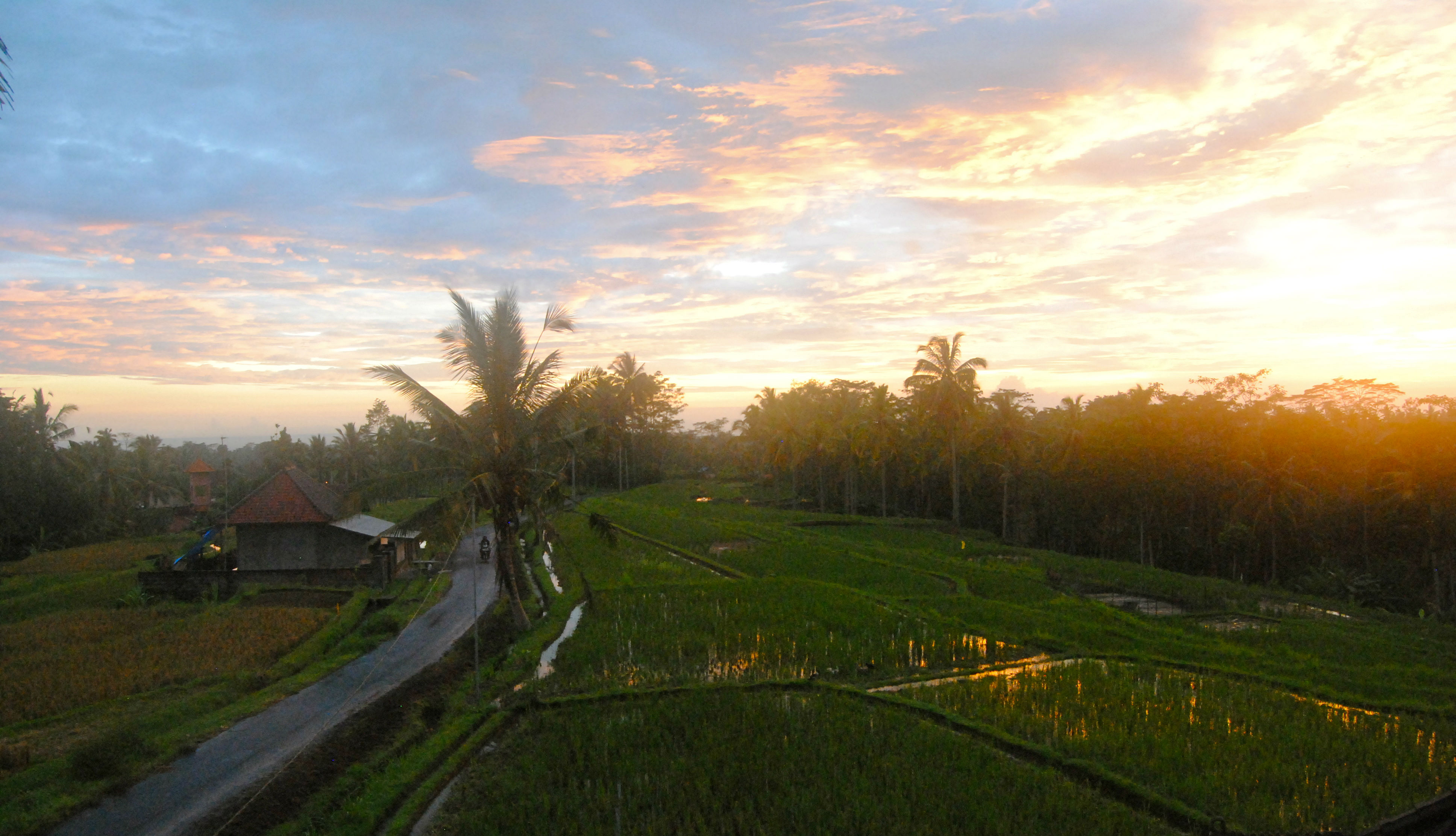
I don’t know why I felt such a connection with Ubud. I just did. And although I’m not the first or even five hundredth person to comment on the spiritual, rejuvenating effect the city can have, it’s still there.  In the beautiful serenity of the rice terraces and Balinese countryside. In the practice of traditional dance and the fine arts. In the quaint stone pavements that guide your feet past lush gardens and temple walls.

And while yes, you can buy Eat, Pray, Love trinkets in the souvenir shops and network with expats at expensive yoga classes, it remains an inspiring and beautiful Mecca that just kind of naturally leads to self reflection. One that I’m hoping we’ll return to very soon.

View from our Homestay apartment, Ubud, Bali

View from our Homestay apartment.

Homestay Sunset, Ubud, Bali

Homestay Sunset

Holy Spring Water Temple, Ubud, Bali

Holy Spring Water Temple

Holy Water Blessings, Ubud, Bali

Holy Water Blessings

Ubud Tourist Village, Bali

Ubud Village Children

Statue Offerings Ubud, Bali

Statue Offerings

street Ubud, Bali

Forest Path, Ubud, Bali

Strolling With Our Host

Strolling With Our Host

The Rise of the Apes, Monkey Forest, Ubud, Bali

Rise of the Apes

Barong Dance in Ubud, Bali

Barong Dance

Balinese Dance, Ubud, Bali

Balinese Dance

Monkey, Ubud, Bali

Enjoy the show.

Enjoy the show.

Legong Dance, Ubud, Bali

Legong Dance

Yoga Barn, Ubud, Bali

Yoga Barn

We Were There, Ubud, Bali A Cruising Couple

We were there!!!

Mount Batur, Ubud, Bali

Mount Batur

Anything that has to do with poop is automatically deemed either childishly humorous or just super gross. Even saying the word out loud might bring a chuckle along, especially if you’re of the same maturity level we are. Of course, there is always an exception. In this case, it’s Bali’s lowak coffee. I was lucky enough to get a sip of this extra smooth, velvety cup of Joe, freshly roasted via coffee beans a civet pooped out. And yes, that’s correct—I actually thought it tasted phenomenal. Especially once I got the fact out of my head that it had already passed through the digestive track of a luwak—which are SO cute, btw. Unfortunately, Dan detests everything about coffee, so while he can’t quite be included in the sentiment, I did get him to admit that extra-sugary-vanilla-milk-with-a-hint-of-coffee is okay. After six years of trying, I’ll take it.

While we might be in discrepancy about the coffee, we are certainly in agreement about the rest of Bali. There will be lots of photos and descriptions in the near future, but until then, here’s a bit of an appetizer: just a few of the things we love about Bali. Hopefully it will entice you to come back for seconds. And thirds. And maybe even fourths.


10 Things We Love About Bali


1. The View From Our Room at Suara Ombak

That’s Dan. He’s in our room. And that’s the panoramic view of the Bukit Penninsula, including major surf spots like Bingin Beach and Dreamland. I guess you could say we’re comfortable.

Suara Ombak, Bali A Cruising Couple

2. The Photogenic Monkeys

Sorry, I just had to pick two pictures for this one. I mean, let’s be honest, they are just too adorable to turn one away. Although, I guess if I have to choose, the one that’s falling asleep might win by just a tad. We also have one where its eyes are half closed— again, SO cute.

monkey, Bali

sleeping monkey, Bali

3. The Sunsets

We already posted a picture of a sunset here, but we just had to include this in our list of favorites. While this is also a picture taken at Jimbaran Bay, the sunsets are amazing every night from almost any location.

Jimbaran Bay, Bali

4. The Pool at Puri Bambu

The Puri Bambu is a great hotel for an exceptional value. We were especially in love with the pool, and its swim-up bar. Although the prices wouldn’t really convey it, you can expect resort quality service here.

Puri Bambu, Bali

5. Ubud

If the monkeys are photogenic, we don’t even know how to describe Ubud. It’s a sort of photographer’s paradise, with picture taking opportunities around every corner. This is especially an issue for me as I am obsessed with cute alleyways, decorative doorways, and vibrant gardens. I’m pretty sure Dan is getting sick of hearing, “Take a picture of that! No wait, take a picture of that!” Which I say, oh, probably about 30 times a day.

Ubud, Bali

6. Surfing the East Coast

I really don’t surf at all. Which is unfortunate, because I think surfing is pretty rad. But even I couldn’t resist renting a board and having a go in the perfectly turquoise water at Padang Padang. While I might have epically failed, Dan has been doing a great job catching waves, even if it’s currently Bali’s off season.

Unknown surfer, Bingin Beach, Bali

Unknown surfer

7. Yoga Yoga Yoga

If Dan has surfing, I have yoga. I have been so excited to finally have a vacation where I can really let go and spend more time on my practice, and luckily there are lots of hippies in Bali to help me.

yoga, Bali

8. Legong, Ramanyana, and Barong Dancing

There’s lots of traditional Balinese dancing to be seen, and we have really been enjoying some of the shows available. Ubud has been a great place to take advantage of the live shows offered every night of the week. One of our favorites was the Legong dance (pictured here), seen outside the Ubud Palace.

Legong, Ubud, Bali

9. The Bukit Peninsula

This is the paradise I imagined Bali to be. Stunning vistas, beautiful beaches, and lots of opportunities for those photos of me contemplating life. This is one of the few shots where I actually had no idea Dan was quietly stalking from behind.

Uluwatu, Bali A Cruising Couple

10. The Balinese People

people bali

Maybe this one sounds a bit cliché, but it is most certainly true. Balinese people are warm and inviting, and we feel very lucky to have met so many incredible hosts in such a short time. This beautiful and regal woman below had one of the most serene smiles and genuine handshakes we’ve encountered so far.


It was really hard to narrow down all the things we love about Bali to only 10. So don’t be shy–tell us, what do you love about Bali? 

Dan doesn’t normally help too much with writing the blog posts because he ‘claims’ he’s no good at it. Which is a shame, because we all know he is absolutely hilarious. Normally he will oblige me by going back into the posts and adding his own zingers here and there. For Yogyakarta he’s done the same; but now we’re mixing it up with a bit of I Spy Dan’s Writing. See if you can’t find which parts he wrote in his oh-so-Dan-style.

Water Temple, Jogja

A home, Jogja

Yogyakarta (Jogja) is a small city in Java, often referred to as the arts and cultural capital of Java. It’s a hub for tourists that make it their base for the famous temples Borobudur and Prambanan, as well as those booking tours to head east to Mt. Bromo. (Just like us.)

Jogja has a lot to offer visitors within the confines of the city, though we found most of these things doable in one day.

The Batik ‘Scam’

Batik Paintings, Jogja

Everywhere you turn in jogja, someone will be trying to sell you batik. If they aren’t outright selling it, they’ll be referring you to a friend’s shop down the road where someone else will be trying to sell it. They may even try to sell you a washer and dryer before directing you to the local batik art shop. Of course, that was where we found the best selection: Jogja Art Group. Everyone knows it, including the appliance shop owners nearby. You might hear that the Yogya Art Group is only open certain days of the week, but we’re not sure if this is accurate or just a way to get you to shop immediately. Nonetheless, if you find it open, go inside. There you can watch a batik demonstration, where the owner will explain the process of dying the fabric, coating the areas you don’t want re-painted with wax, and then dying the fabric again. This process is repeated over and over until the desired picture is achieved.

Batik Painter, jogja

Although the demonstration is interesting, obviously the best part is actually shopping for the batiks. Dan and I don’t collect much when we travel, but we have taken to buying art to display in our home one day. Batiks are perfect for this as they easily fold up. When you are ready to display them, just get out your iron to get rid of any creases and there ya go. So here it is: the scam. There are lots of people in Jogja selling printed batiks. Apparently there are two ways to tell if it is handmade:

1. Look at the back. It should look the same as the front.

2. Put it in water to make sure the paint doesn’t run.

I’m no Batik expert, but they all looked pretty good to me. The prices are pre-marked according to the painter (student or master), which keeps the sellers from charging absolutely extortionate prices, but we found you could still negotiate a bit. We ended up leaving with three batiks I absolutely adore for what I found to be very reasonable prices, especially after watching all the time and effort that goes into creating the works of art. Are they actually authentic? We’ll probably never know. We’ve heard mixed things from the Jogja Art Group, but we’re really happy with what we bought and I guess that’s all that matters.

If the previous paragraphs of our batik experience are a bit too lengthy for you, feel free to just read this eloquent summary: Practical and picturesque, these precious pretty portraits prices are profoundly painless on your pocket. Public painters in the proximate population prepare every part of every painting. The paint on the paintings is painted with protective wax, to protect the paint. We promptly picked a pair Pablo Picasso (or possibly Peter Piper) would be proud of.

Handmade Puppets: A little more fancy than your average brown paper bag

Making Shadow Puppets, Jogja

I’m not really a puppet person. Actually, I don’t think I know anyone who is a puppet person. But the puppets you’ll find in Yogyakarta are just plain cool. Shadow puppets are an ancient Indonesian form of storytelling, consisting of wooden puppets maneuvered behind a shadow screen, with accompanying gamelan music. The puppet shops are almost as common as batik, and you can also find a puppet making demonstration in most of the shops. The process looks like it requires painstakingly steady patience—something I definitely don’t have. To make the handcrafted shadow puppets, the artist begins with a piece of buffalo skin. After it is cut to the desired shape, various sized chisels, which are recycled from old bicycle spokes, are used to ingrain intricate and delicate patterns. On the bottom third of the puppet, near the feet, you’ll find four different patterns that represent the four elements of nature: earth, wind, water, and fire. With their powers combined, they continue up to the middle portion of the puppet, where you would find the heart. Here the patterns change to resemble the rising and falling of human emotions. Finally, the top portion of the puppet contains designs that signify the crown of knowledge. After the chiseling process is finished, the painting can begin. It’s another tedious task that results in a beautiful, intricate, one-of-a-kind puppet.

Shadow Puppets, Jogja

Shadow Puppet, Jogja A Cruising Couple

After learning all about the shadow puppets, we recommend seeing an actual shadow puppet performance. They are held every night of the week (except Sunday) outside of the Sonobudoyo Museum for a mere $2. The cool thing about these shows is that the stage is 365 degrees. You can sit and look at the shadow puppet show, then walk around to the ‘behind the scenes action’ where a gamelan and live singers are set up. This is especially neat during the puppet fighting scenes when the puppet master is twirling the puppets around his head and throwing them into the air. It’s not exactly a heavyweight championship, although we would love to see a crowd out of their seats cheering and jeering for puppets. If you do attend a showing, be aware that it is two hours long with no English translation. We had no idea what was going on during the performance, so we left after about an hour, which appeared totally acceptable.

Shadow Puppet Show, Jogja

Puppet Show, Jogja

Puppet Show Gamelan, Jogja

The Local Pick: Gudeg

Warung, Jogja

I love food. It’s seriously one of my favorite things about travelling. I especially love eating new food in a small, cheap restaurant crowded with local people. We struck gold in Yogyakarta with Gudeg, a dish distinctive to the Javanese city. It doesn’t look all that appetizing at first. Most of the colors on the plate are actually of a brownish hue, and the only thing we could initially recognize was a chicken thigh. We skeptically followed the ‘at least one bite’ rule, and were quite impressed by what we tasted. It was actually like nothing we had ever tried before. Gudeg is primarily made from jackfruit that has been boiled for several hours with various seasonings, and is served with rice, chicken, hardboiled eggs, tofu, and crispy beef skins.

Gudeg, Jogja

I don’t know Jack, but he picked a hell of a tasty fruit.

Strolling About the Sultan’s Palace

No traffic, Jogja

Traffic, Jogja

For those who are unfamiliar, sultans are short, fat kings who have friends with magical powers, talking animals and know big blue genies. Yogyakarta just so happens to have its own sultan’s palace. While we didn’t pay to go inside, we did spend an afternoon getting lost around the area. There are beautiful side streets off of chaotic city roads, as well as a mini-fair with loads of local foods to try. It can be quite an exotic experience walking this area amongst the loads of rickshaws and horse carriages while hearing islamic chanting from the mosques, all the while smelling the spicy, deep-fried street food. Although contrary to what you might think, it’s a refreshing contrast to the main tourist street where the foreign hostels and restaurants are primarily located.

So who did it? How many Dan-isms can you find? :-)

Aug 252012

Aug 252012

© 2013 A Cruising Couple Google Header design by Canary Design Suffusion theme by Sayontan Sinha
  • RSS
  • Facebook
  • Twitter
  • Flickr
  • Pinterest